Four weeks living with the Dreamcast and here's where I've landed: this is a fantastic console, and it's the one machine of its generation that people still routinely overlook. If you're a fan of arcade gaming, you simply can't not be a fan of the Dreamcast. It's the best console ever made for bringing the arcade into the living room, bar none — and there are games on it you can't play properly anywhere else.
I should say up front that the PlayStation 2 is probably my favourite console of all time. I absolutely love it. So none of what follows is me hating on the PS2 to prop up Sega. It's just that when you actually put the two side by side, the story is a lot less one-sided than the sales figures suggest.
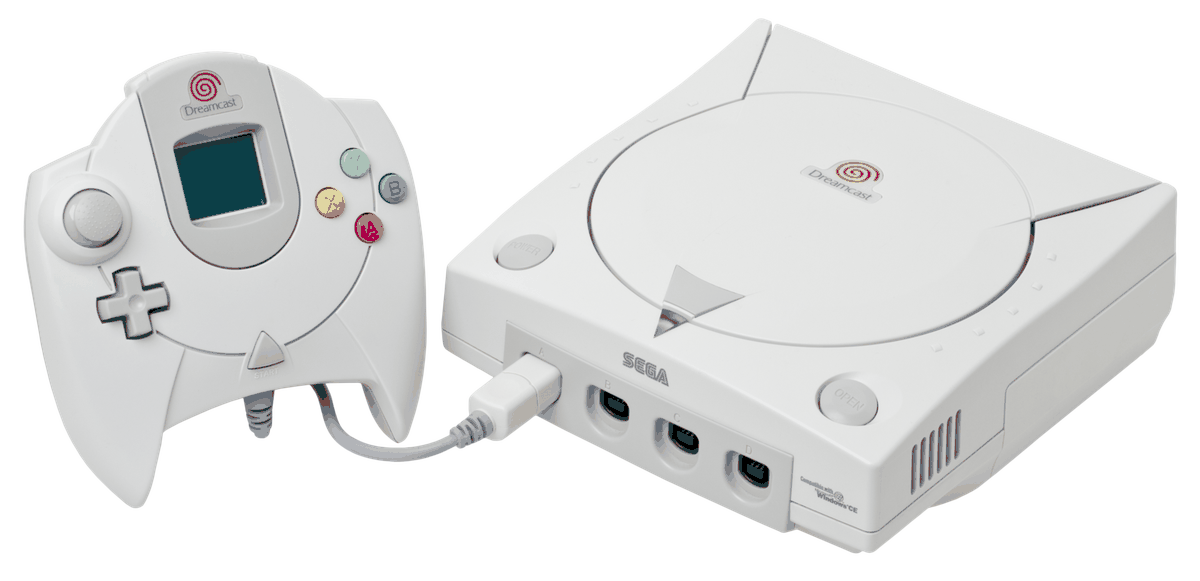
Why it failed — and why that doesn't erase what it did
The usual telling starts and ends with "it was killed by the PS2". The reality is more nuanced. The PS2 probably delivered the final blow, but Sega's finances had already been shattered by the Mega CD, the 32X and the debacle that was the Saturn. Third-party confidence was in the toilet. Years of fragmented strategy left the company fighting an almost impossible uphill battle before the machine had even launched — a lot of developers had simply had their fingers burnt.


Development began in the mid-1990s under the codename Katana, and the goal was a machine that was powerful, affordable and — crucially — easy to develop for. Where the Saturn was notoriously complex, the Dreamcast was built around Hitachi's SH4 and PowerVR graphics, so developers could get results without fighting the hardware. Because the Naomi arcade hardware shared so much of that architecture, games could move from the arcade to the living room with remarkably few compromises.
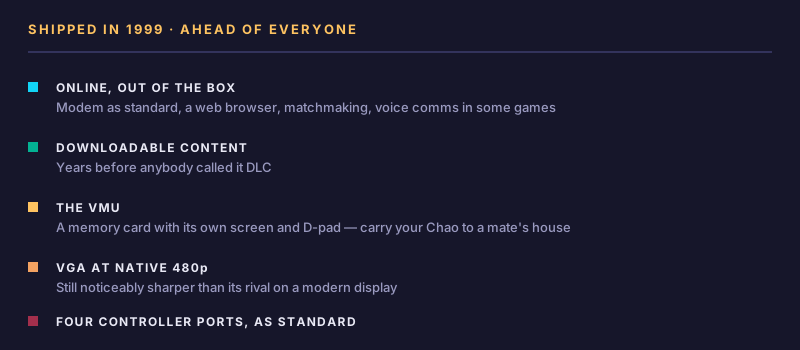
They were doing online gaming before that was a thing. Nobody knew whether it was going to catch on. That was incredibly risky and incredibly forward-thinking.
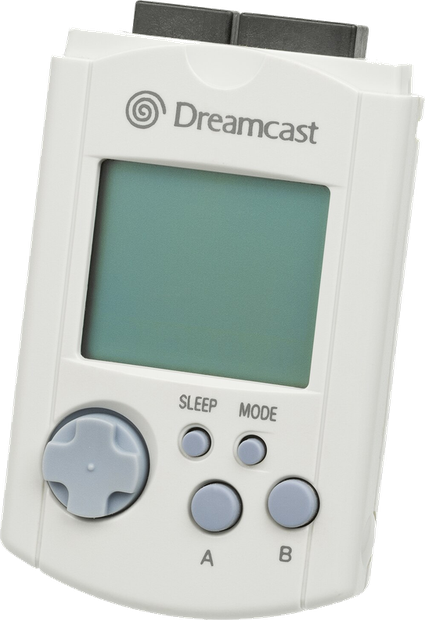
The modem was built in as standard. There was a web browser, online matchmaking, voice comms in some games, downloadable content before anybody knew what DLC meant, and the VMU — a memory card with its own screen and its own D-pad, running mini-games and letting you carry your Chao out of Sonic Adventure and round to a mate's house. I'm genuinely surprised nobody has properly done that since. The closest we got was hooking a Game Boy Advance up to a GameCube, and this came first.
Then the games. Arguably one of the strongest launch windows in gaming history: Soul Calibur redefining what a console fighter could look like, Crazy Taxi, Virtua Tennis, Sega Rally 2, Power Stone, Jet Set Radio, Shenmue. For one brief moment it genuinely felt like Sega had rediscovered its magic. And the influence lingers — Shenmue laid foundations for open-world storytelling, Jet Set Radio popularised cel-shaded visuals before Wind Waker, Phantasy Star Online hinted at what online RPGs could become. More than 25 years on, people still refuse to let this machine die: new games, accessories, translations, hardware mods, homebrew. Very few discontinued consoles get that.
The hardware, honestly compared
On raw numbers the PS2 wins. Its Emotion Engine ran at 294MHz against the SH4's 200MHz, it had 32MB of system RAM to the Dreamcast's 16MB, and its graphical ceiling was higher. DVD beat GD-ROM on capacity — around 4GB against roughly 1GB — and being a state-of-the-art console and a DVD player for barely more than the price of a DVD player was a colossal advantage.
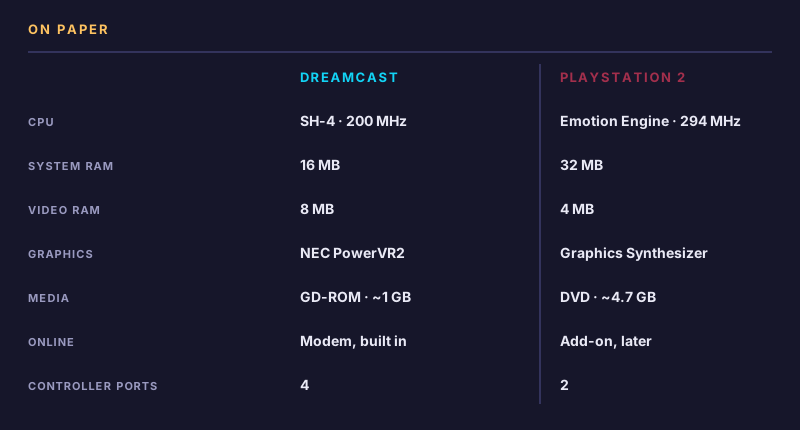
But the Emotion Engine was hard to get to grips with, so the PS2 didn't really show what it could do until later in its life. The Dreamcast was producing fantastic-looking games from day one, and throughout this month I've thought they often look just as good as early PS2 output. The PowerVR2's tile-based rendering wastes very little, and 8MB of video RAM (against the PS2's 4MB, albeit with famously massive bandwidth) went a long way. The audio is exceptionally good. And on modern displays, VGA at native 480p still looks superb — I've been running mine through an OSSC via the VGA adaptor and it's noticeably sharper than the PS2's slightly blurrier picture.
So: PS2 for raw power, graphics ceiling and storage. Dreamcast for ease of development, online out of the box, visual clarity, four controller ports as standard, and sheer innovation. My only real gripe with the controller is that the cable comes out of the bottom — although I've just rediscovered the little groove you can tuck it into.
What I actually played
Virtua Tennis deserves its reputation as one of the best sports games ever made — easy to get into, looks amazing, and a reminder that when EA wouldn't play, Sega Sports just made its own brilliant games instead. Soul Calibur I had to stop playing because I was getting addicted; it's one of Namco's best and one of the best fighters out there. Crazy Taxi is chaotic, silly, very Sega and utterly perfect in short bursts. Sega Rally 2 is excellent — I still marginally prefer the original, possibly through rose-tinted glasses, but the career stuff adds a lot over the arcade version.
The surprise was Metropolis Street Racer, which I'd never played and picked up at a fair for a fiver. It is very obviously the precursor to Project Gotham, and with the weather effects on it still looks fantastic. ChuChu Rocket is mad, maddening and ludicrous, and my son ended up loving it after telling me it looked hard. Sonic Adventure is a proper return to form after the Saturn's total absence of a full 3D Sonic. Ready 2 Rumble Boxing is good fun but surprisingly tough — best played two-player. TrickStyle, which I only had because it happened to be in my collection, was rubbish; apologies to whoever loves it. Toy Racer isn't much use now the servers are gone.
Gaps I couldn't fill: no Shenmue, no Jet Set Radio, no Phantasy Star Online, simply because I don't own them and some Dreamcast games are obscenely expensive and genuinely hard to find.
Getting into it in 2026
There's no reimagined mini, which limits things — Retro Games Limited, I'm looking at you. Sega, you did the Mini Mega Drive; come on. Failing that, emulation works well. Redream is the best-known and you can sponsor for the pro version, but I've had problems with it on the Mac, and Windows CE games won't run there at all. Flycast is what I've been using and it seems to handle everything, with only occasional frame dropouts. RetroArch uses the Flycast core anyway, so it amounts to the same thing. The bigger annoyance is the controller — a PS4 pad is a nuisance for these games, and a modern USB Dreamcast-style pad would be the answer if one exists.
Otherwise, buy the real thing: expect roughly £100–£150 in the UK from markets, CeX or independent shops, and check the optical drive works. Games run from about £10 to hundreds. If you're modding, an SD replacement for the GD-ROM is the one I'd actually consider, since my optical drive is getting long in the tooth. There's also an HDMI kit, a PSU swap, and the battery — there isn't a Dreamcast in the land still running on its original one, so that's worth doing if you can solder. Personally I like machines as nature intended, so the OSSC does the job for me.
Next month
August: the Game Boy. A phenomenon, and a machine so iconic that the word "Game Boy" and mobile gaming are basically synonymous. I never owned one — my friend did, and I played it round his house constantly. Super Mario Land is one of my favourite handheld games and one of the very few Mario games of that era I ever finished. I'm travelling this month, which is exactly when a handheld suits, so I'll be taking Game Boy and Game Boy Color games and covering the two together rather than splitting them. I also want to dig into why a little monochrome device blew colour-screened rivals like the Lynx and the Game Gear clean out of the water.