Sony have announced that from 2028 there will be no more physical game discs. Digital only. And I think that's a genuinely significant moment in gaming history — not just a business decision, but the closing of a door that's been open for around fifty years, all the way back to Atari 2600 cartridges and even a bit before that.
I know plenty of people have already made videos about this and I'll probably be parroting some of the same points. But I wanted to get my thoughts down, because as a retro gamer I think this matters enormously.
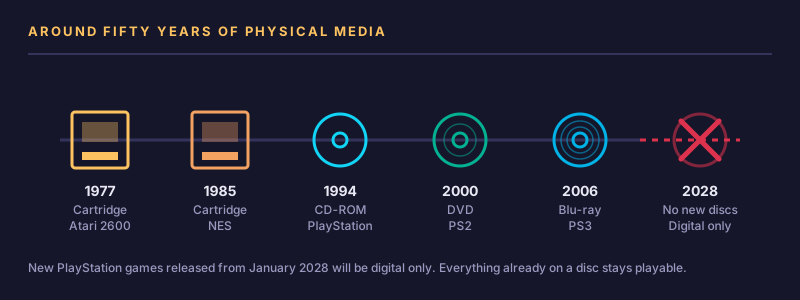
We've been here before — just not quite like this
Let's be honest: none of this is new. Since the PS3 era we've been downloading games onto our consoles, and on PC it's been going on far longer with the likes of Steam. I make good use of it myself — I buy digital on PSN, on Xbox Live, on Nintendo. I've played games through Game Pass and streamed games. That's normal now.
It's also not new in a sneakier sense. Since the PS4 era, you often buy a disc, put it in the machine and then download a huge chunk of data before you can play. Take No Man's Sky — I've got the PS4 version and I play it on PS5, but the entire game is downloaded, I have to be online for it to connect to Hello Games' service, and the disc is basically just a key proving I paid. Increasingly the same on Switch: a little cartridge with next to nothing on it, functioning as proof of purchase.
So in a way we've been living through a golden era — you could buy physical if you wanted to own something, and go digital when it suited. Both options on the table.
The comparisons everyone reaches for are music and movies. Twenty-five years ago I was in conversations where people insisted nobody would ever stop buying CDs — they'd want the cover art, the physical disc. That turned out to be completely wrong. Most people now just have Spotify or Apple Music and never buy music at all. Same story with films: I'll occasionally pick up a Blu-ray or DVD, but buying a physical disc for a movie is genuinely rare now.
Here's where I think the comparison breaks down, though. Music doesn't really date. You can listen to something from any era, even classical music from centuries ago, and it's still music. Games have changed so profoundly that a game from 1990 is a completely different proposition to a game from 2026. Movies date more than music, but still nothing like games do. Gaming is a bit of a unique industry, and that's exactly why going fully digital hits differently.
Why it's bad for everybody
We will never own a game again. It will just be something that we pay a large sum of money to play.
The core problem is ownership. With music, if licensing runs out on one platform you move to another. With films, they'll turn up on a streaming service eventually, and the older stuff exists on DVD and tape anyway. Games are different, because a lot of them need servers. They're expensive to host. And one day Sony — who own a lot of their own games — can look at a title with a handful of players left and decide it's not worth keeping the lights on. That game is gone forever.
I played a modern Afterburner a few months back, I think on the 360, and if you hadn't already grabbed the digital version, that was it. Gone. At least in that case, if you owned the download you could still play. Nowadays you might own the download and still not be able to play, because the server bits it depends on have been switched off. When Hello Games turn off the No Man's Sky servers, that's it. No more No Man's Sky. It only lives in our memories.
Then there's everything else that disappears with the disc. No lending a game to your brother or your mate. No secondhand market. And no market means no pressure on price. At the moment I quite often find the physical copy is cheaper — sometimes significantly — than the digital version on PSN. Take physical away and Sony set the price and can keep it there forever if they fancy. In the secondhand market, price follows demand: if a game isn't very good but you still want to play it, you can pick it up cheap. That goes away. It'll be a great money-making machine for Sony and worse for the rest of us.
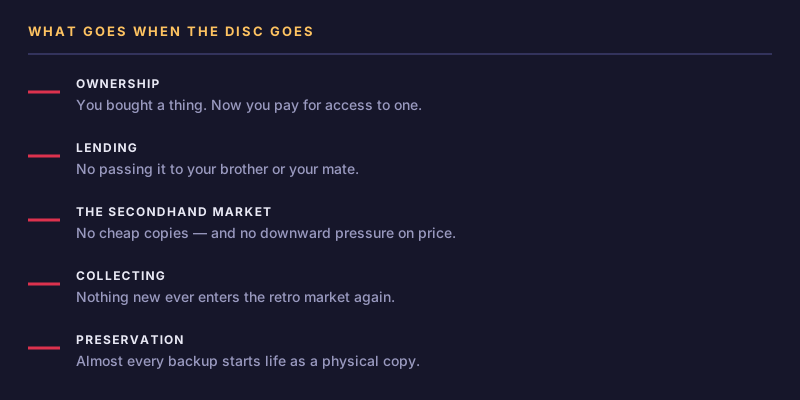
Why it's devastating for retro gaming specifically
This is the part I keep coming back to. If I can find an Atari 2600, I can play a 2600 cartridge for as long as that cartridge survives. That's the deal we've had for half a century.
Now think twenty years past 2028. The retro gamers of that era will still be able to collect PS3, PS4, maybe some PS5 games. But after 2028 it stops dead. That whole twenty-year period will exist only for as long as Sony, Microsoft or Nintendo choose to keep it published on their storefronts. You won't own it. You can't collect it. There'll be no retro scene as we know it today.
People will say there's always emulation and online libraries. But where do those backups come from? Physical media in the first place. If there's never any physical media, that source dries up. There'll be no vault of games except the vault the platform holders decide to fill.
And it goes beyond the games. Think about the businesses. We've already watched a lot of the UK high street go — Game has pretty much vanished as dedicated stores, just a few concessions in Sports Direct now; Electronics Boutique long gone; HMV had to change or disappear. CeX survives largely on secondhand games, music, movies and tech, and in twenty years the games side of that just won't be a thing — you'll only be able to buy games from now and earlier. Saddest of all for me are the gaming markets I go to, full of independent sellers with games, consoles and old hardware. They'll last a while, but nothing new is ever coming into the retro market behind them. The old stuff gets older, rarer and more expensive, and there's nothing following it. There's some hope in the likes of Evercade still pushing physical, but that's retro games, not anything new.
And on a personal note: I'm quite sad I won't own a copy of Grand Theft Auto. Apparently you'll still get a box with a download key in it. I hope the map and the other bits survive, because that's half the fun of buying a GTA game. It'll certainly eat a lot of space on my PlayStation.
Where there might be a ray of sunshine
Let me be fair, because there is an upside — heavily caveated.
Everyone gets nostalgic about Blockbuster Friday nights. Was it though? Two hours out of your evening, an overpriced rental that probably wasn't the film you wanted because they'd already got shot of it, ludicrous popcorn, and then a fine for not rewinding the tape. It was an experience, but it wasn't all great. Now I watch what I want when I want. In theory that's the future for gaming too, and that's genuinely good.
Choice is the other upside — and the other problem. I've built up a huge library from the monthly PSN games over five or six years and I've played maybe one per cent of them. I don't know where to start, so I gravitate to the AAA titles anyway. It's the same thing that happened to me with music: I used to buy an album and play it to death, know every lyric. Now I just pull up a curated playlist. There's almost too much choice. But Game Pass has loads of genuinely good games on it, and being able to just play something without buying it is brilliant.
For older games, all is not necessarily lost. Nintendo Switch Online gives you the old systems, including Mega Drive. There are a fair number of older games on PSN and on Microsoft's side too. But there aren't millions. A lot of what I want to revisit simply isn't there.
So here's my hope, and it's the tell for me. Sony say they'll save money not producing physical media. I want that money reinvested in the libraries, in keeping games alive longer. If we get to a point where gaming works like Spotify or Apple Music — where pretty much anything by anyone is there, and every game that's ever made stays on the system — then we might have a fighting chance of a retro scene in twenty years. I'm somewhat sceptical, I have to say.
I get it. It's still bad.
I've spent my whole life alongside and working in technology, so I understand exactly why Sony are doing this. From their point of view it makes good business sense. And all the threats about people jumping ship are short-lived — Sony know people will be angry and they know it'll be a blip. Where would you even go? Microsoft have been pushing this for years with Game Pass, and it's a really good service. Valve have only ever done things this way, and there's the Steam Machine coming. Nintendo have been doing it by stealth — don't kid yourself that a Switch 2 cartridge means you're buying a full game. All of them are at it. Sony's announcement only feels bigger because they were furthest behind, and their online service arguably isn't as good as Microsoft's.
I also expect the money side to shift: more subscription, less buying. Sony moving closer to the Game Pass model, where most AAA titles just come with your sub, apart from a few like GTA. That could be good.
But it marks the end of an era, and not in a good way. It's bad for retro gaming and I think it's bad for the industry right now. I'd genuinely love to be proven wrong — I hope I am. What I want most is for Sony, Microsoft and Nintendo to recognise there's a history worth keeping, to offer more older games and keep them alive and available forever, ideally, so they're not simply lost. That's the most worrying aspect of all of this.