Every time I finish researching one of these month-long deep dives, I end up in the same place: what if? Last month it was the Amiga. This month it's Sega — and unlike a lot of failed consoles, the Dreamcast wasn't short of great games, or innovation, or ambition. If anything it was a little too ambitious.
So let me be clear about the rules I'm playing by, because this isn't fan fiction. I'm not going to pretend Sega suddenly shifts 150 million consoles and reduces Sony to a footnote. That's simply not realistic. The interesting question is much smaller: what's the tiniest change in history that could have completely altered the future of the games industry? Because history does turn on those small moments. If Nintendo had accepted Sony's CD partnership, there might never have been a PlayStation at all.
I'm not imagining a world where Sega wins the console wars. I'm imagining a world where Sega simply stays in the fight.
The problem was never demand. It was cash
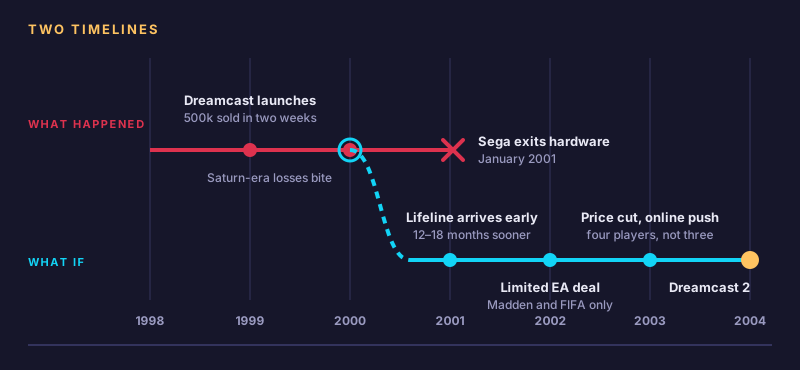
When the Dreamcast launched in 1999 it wasn't a failure — far from it. In North America, Sega sold over half a million consoles in two weeks. Reviewers loved it, players loved it, and for the first time in ages retailers were optimistic. It looked like Sega was back.
But years of Saturn-era losses meant the Dreamcast didn't just have to succeed, it had to succeed immediately. Every quarter mattered. There wasn't enough money left in the business to weather a long fight.
That's where my timeline diverges — not with a miracle, but with a lifeline. In reality, Okawa, chairman of CSK and one of Sega's biggest supporters, personally forgave hundreds of millions of dollars of Sega's debt and transferred shares back to the company towards the end of his life. Valuable breathing room — but by then the decision to leave hardware had already been taken. What if that support had arrived 12 or 18 months earlier? Enough to reassure investors, enough to convince retailers Sega wasn't about to vanish, enough to buy one more holiday season. One more year for broadband to become common. One more year before people wrote Sega off entirely.
Stack a second small change on top: EA. That relationship collapsed largely because Sega wanted to keep control of its own sports franchises, particularly NFL 2K. So there was no FIFA, no Madden, no NHL, no Need for Speed — and in North America those weren't just absent games, they were system sellers. I'm not suggesting EA becomes Sega's best mate. Just a limited publishing deal. Just Madden and FIFA. Would that alone have saved Sega? Probably not. But we're stacking small changes, not giant ones.
Add timing. The PS2's first year wasn't flawless — developers struggled with that notoriously complex hardware, and plenty of early games looked much like what we'd already seen on Dreamcast. Some were arguably worse. In my timeline Sega doesn't panic; it doubles down. Arcade-perfect conversions, push the online story, cut the price. The message writes itself: why wait for tomorrow when you can play the future today?
Sega owns the arcade
Survive into 2002 and the sixth generation has four players instead of three. And the Dreamcast's greatest strength was never raw power — it was personality. A console built by an arcade company: fast, colourful, immediate. It wasn't trying to replace your DVD player. It just wanted you to have fun.
So Sega becomes the anti-PlayStation. Sony owns cinematic gaming, Nintendo owns family gaming, Microsoft owns online shooters — and Sega owns the arcade. House of the Dead, Virtua Tennis, Crazy Taxi, Outrun 2, Ferrari F355 Challenge. They hadn't forgotten how to make games. The problem was getting people to play them at home.
The other head start was online. The Dreamcast shipped with a built-in modem in 1999; the PS2 needed an adaptor later. Sega bet the ranch on internet gaming years before Xbox Live, years before PlayStation Network, years before most homes had broadband. In reality the world wasn't ready. In my timeline, Sega survives just long enough for everyone else to catch up — and Phantasy Star Online had already proved console players wanted connected experiences.
What Dreamcast 2 looks like
By 2004 the hardware is long in the tooth, so there has to be a successor — and I don't think Sega tries to win on processing power. That was never their style. They'd ask a different question: what console could only we build?
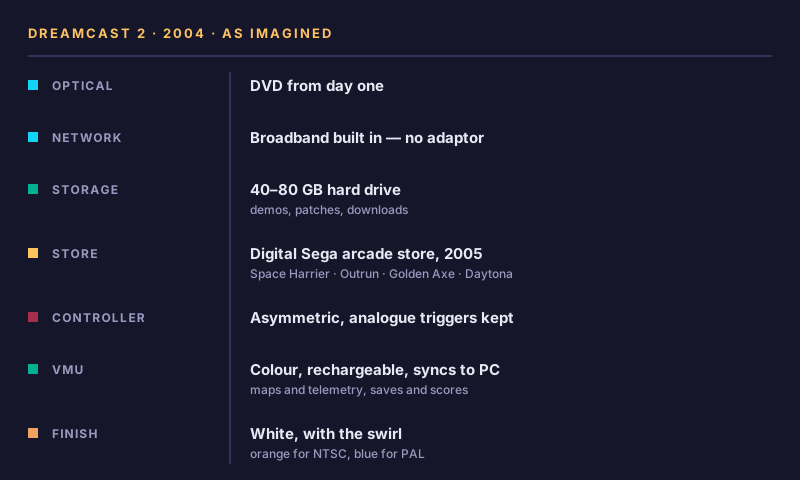
DVD from day one, because by 2004 it simply made sense. Broadband built into every single console, no adaptor, no compromise — that's not even speculation, Sega had been talking about broadband since the original machine. A hard drive, maybe 40 or 80 gig, enough for demos, patches and downloads. And then the bit that genuinely excites me: a digital Sega arcade store in 2005. Space Harrier, Outrun, Golden Axe, Virtua Fighter, Daytona USA, House of the Dead, instantly, years before digital storefronts were normal.
The asymmetrical controller stays. The analogue triggers absolutely stay — they were years ahead of the competition. And the VMU evolves rather than dies. I'll admit I think the VMU was brilliant and a bit ridiculous: it chewed batteries, the screen was only ever useful in a handful of games. But the idea was genius. Give it colour, make it rechargeable, let it show maps and telemetry, let it sync with your PC for saves and scores. Not because we know Sega would have — because it's entirely consistent with how Sega thought.
And it stays white with the swirl. Orange for NTSC, blue for PAL. You'd know it from the other side of the room.
The Microsoft question
Here's the detail people forget: the Dreamcast wasn't just built by Sega. It supported Windows CE as a compatibility layer to help bring PC games across. Not every game used it — plenty of the big titles ran on Sega's own tools for performance — but the partnership existed. These two companies already knew each other.
Meanwhile Microsoft was terrified of Sony owning the living room. That fear is a big part of why Xbox was born; it wasn't just about games, it was about protecting Microsoft's future. So if Sega is still standing, Microsoft has a choice: spend billions building a console from scratch, or deepen a partnership it already has. Maybe Xbox Live launches as the online service for Dreamcast 2. Maybe Halo becomes a Sega exclusive — Master Chief on a Sega console. And before anyone rushes to the comments, Microsoft has never been shy about buying gaming companies: Mojang, Bethesda, Activision Blizzard. Buying Sega in the early 2000s would have given them an instant foothold in Japan, which Xbox struggled with for years.
My honest verdict? I think Microsoft would have bought Sega, and I don't think we'd ever have seen the Xbox at all. Which is a lovely irony, given how many people call the Xbox the Dreamcast's spiritual successor.
The reality check
I'm ever the optimist, so let's be fair. Even with every change I've described, Sega isn't swimming in cash. Console generations cost billions — R&D, tooling, marketing, developer support, online infrastructure. Sony could afford it, Nintendo had decades of stability, Microsoft has bottomless pockets. Sega didn't.
Third-party support stays brutal too. Even with another five or ten million consoles sold, Square Enix almost certainly isn't moving Final Fantasy across, and Activision isn't prioritising Dreamcast over Xbox. And then there's management — Sega of Japan versus Sega of America, different priorities, different strategies, decisions slowed to a crawl. It's exactly the Commodore problem. Neither company failed because they couldn't build brilliant machines. They failed because a technology business needs consistent leadership, financial discipline and a coherent long-term strategy, not just brilliant engineers.
So would Sega still be making consoles in 2026? Honestly, I don't know. Maybe they'd have carved out a smaller, respected niche the way Nintendo did in the Wii era. Maybe HD development costs catch up and they leave hardware in 2012 instead of 2001.
What we actually lost
After nearly a month back inside this story, I've realised that whether Sega survived isn't really the point. The point is that they could have. The gap between the world we got and the world we might have had is much smaller than I'd ever appreciated. History wasn't decided because the Dreamcast was a bad console. It was decided by finances, timing, business decisions and a handful of missed opportunities.
What the industry lost wasn't a manufacturer. It was a way of thinking. Sega greenlit ideas no focus group would ever approve — Typing of the Dead, Space Channel 5, Rez, ChuChu Rocket. Some were hits, some were cult classics, some baffled everyone. But they were never boring. And once Sega stopped needing games that sold hardware, that pressure to be strange disappeared with it.
We've had wonderful consoles since. But I do wonder how many bold arcade experiences and gloriously weird games never happened because Sega wasn't there to challenge everyone else. So no, I don't think they'd have won. Sony was too big, Microsoft too rich, Nintendo's brand too strong. But surviving, building one more console, continuing to innovate? I honestly think that was possible.
Somewhere in another timeline there's a white console glowing under a telly, an orange swirl lighting the room, a new Crazy Taxi just out, Shenmue finished years ago — and someone arguing online that Sega's latest machine is better than the PlayStation. Wouldn't that have been something?