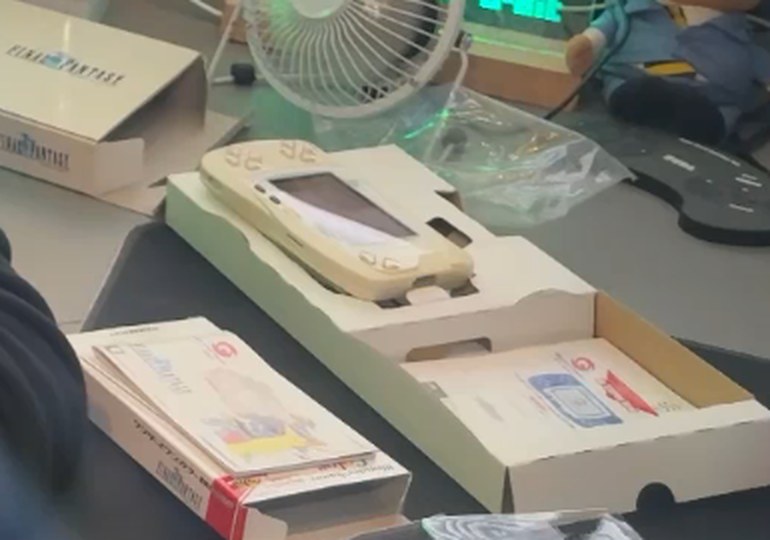
Every so often it's worth just sharing what's landed in the collection, and this time there's one pickup that stands head and shoulders above the rest: a boxed WonderSwan Color, special edition, complete with Final Fantasy. I never had one on my list. Then I made a video about Gunpei Yokoi, went down a rabbit hole, and changed my mind entirely.
The machine Yokoi never saw
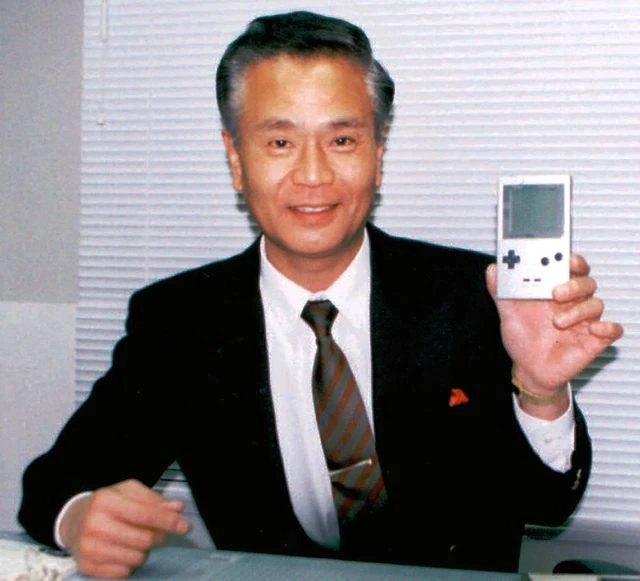
For anyone who hasn't come across it, this is the handheld Yokoi designed after he left Nintendo off the back of the Virtual Boy — whether he jumped or was pushed is still argued over. He set up Koto Laboratory, teamed up with Bandai, and was the brains behind the WonderSwan.
He never saw it launch. He was killed in a road accident in October 1997, aged 56, which is a horrible loss when you think about how much of Nintendo's design language came from him: the Game & Watch, the Game Boy, the D-pad that's now synonymous with gaming everywhere. The WonderSwan didn't reach shops until March 1999, a year and a half after his death.
Everything that mattered, nothing that didn't
The WonderSwan is very much his thing. Not the most powerful hardware, but hammering home the stuff that actually matters in a handheld — which is exactly the philosophy that produced the Game Boy in the first place.
The original ran for around 40 hours on a single AA battery, which is faintly ridiculous. It weighed under 100 grams. It launched at ¥4,800, well under a Game Boy Color, and that price is a big part of why it did well in Japan. There's a lovely bit of Yokoi thinking in the controls, too: two sets of face buttons, so you can turn the thing on its side and play in portrait as well as landscape. Some games are built vertically and you simply rotate the console.
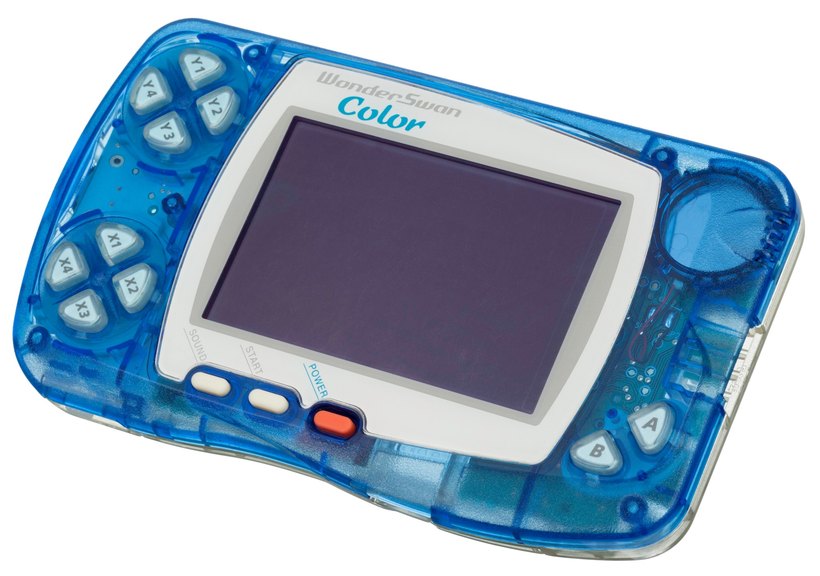
The Color arrived in December 2000 at ¥6,800, with a 2.8-inch screen showing 241 colours at once from a palette of 4,096. Colour costs you, though: battery life drops to about 20 hours on that same single AA. Still roughly twice what a Game Boy Color managed on two.
The one real downside — on every model, including mine — is that there's no backlight at all. You need decent light to see anything, which in 2026 takes some getting used to.
Not the most powerful hardware, but hammering home the stuff that actually matters in a handheld.
The Final Fantasy deal
Bandai's cleverest move wasn't hardware at all. Square — then still very much at odds with Nintendo after the PlayStation defection — agreed to remake the early Final Fantasy games for the WonderSwan Color. Final Fantasy arrived alongside the Color in December 2000, with II and IV following.
That's an extraordinary thing to land. For a brief window, the only way to play a proper modern Final Fantasy remake on a handheld was on Bandai's machine, not Nintendo's, and it took the WonderSwan to as much as 8% of the Japanese handheld market. Bandai leaned into it with limited-edition consoles built around the games — which is exactly what mine is.
It didn't last. Square eventually made its peace with Nintendo and took Final Fantasy to the Game Boy Advance, and once that happened the WonderSwan's biggest advantage simply evaporated. Across its whole life the family sold about 3.5 million units — 1.55 million of the original, 1.1 million of the Color. Respectable in one country. Nowhere near a Game Boy.
Mine, and the catch
It came from eBay, from a chap selling off a load of his stuff. Always a bit of a risk, but he had a good rating and it was cheaper than others I'd seen. It arrived immaculate — not a single scratch, just a touch of yellowing on the battery compartment, which barely shows against that pearl white. The Final Fantasy manual looks like it's never been opened. Everything's in Japanese, naturally, so I'm going to be leaning on my phone for a while.
The catch is games. They're all imports, a lot of them Japanese-only, so I'll be hunting at fairs and hoping. I suspect this one mostly ends up alongside my Neo Geo Pocket as a lovely curiosity to show people rather than something I actually play. I also reckon now's the time to buy — I can't see these getting cheaper.
Which is a strange thing to say about the best purchase of my year. But that's collecting, isn't it. Sometimes the thing you want isn't a game to finish — it's the last machine a brilliant designer ever worked on, sitting in its box, in a language you can't read, doing forty hours on one AA battery.