As of 1 August, an Xbox Series X with a disc drive costs £669.99. It was £499.99. That is £170 more, overnight, for a machine that launched in November 2020 — hardware that is nearly six years old and has not been revised, improved or replaced.
In the US it's gone from $649.99 to $799.99, up $150. The Series S, the cheap one, the one that was supposed to be the way in for people who couldn't stretch to a Series X, is now £429.99. It launched at £249.99.
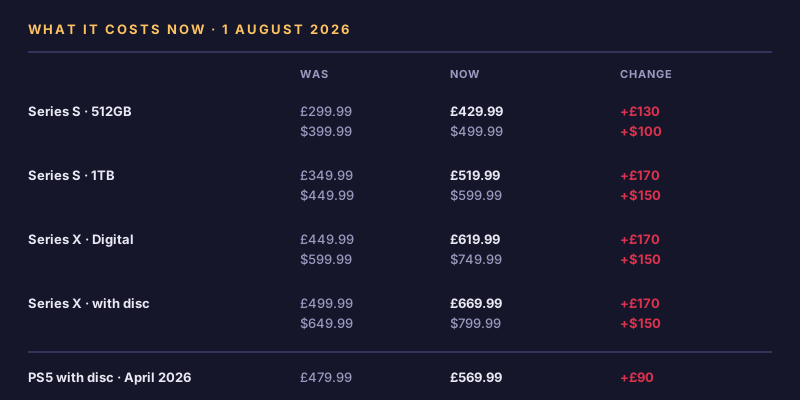
I want to be careful here, because there is a real reason and it isn't a conspiracy. Memory and storage prices have gone through the roof — Microsoft says they've more than doubled, and expects them to double again by autumn 2027. The AI data centre boom is eating the world's memory supply, and consoles are just another customer in a queue they're no longer at the front of. Sony put the PS5 up £90 in April for the same reason. Nobody is doing this for fun.
But understanding why a thing is happening doesn't make it not a disaster.
Consoles are supposed to get cheaper
This is the part that breaks my brain. The entire logic of console gaming, for thirty years, has been that you wait. The machine launches at a price only the keen will pay, and then it comes down. That's the deal. That's why your mate who waited two years got the same console for a hundred quid less and a better pack-in.
The Xbox 360 launched here at £279.99 in December 2005. By September 2008 the Premium was £169.99, and the Arcade model was £129.99. Down £110 in under three years, and that's before you account for what £280 was worth in 2005. The PS2 did the same, over and over, all the way down to budget-shelf money. Every generation, the graph pointed the same way.
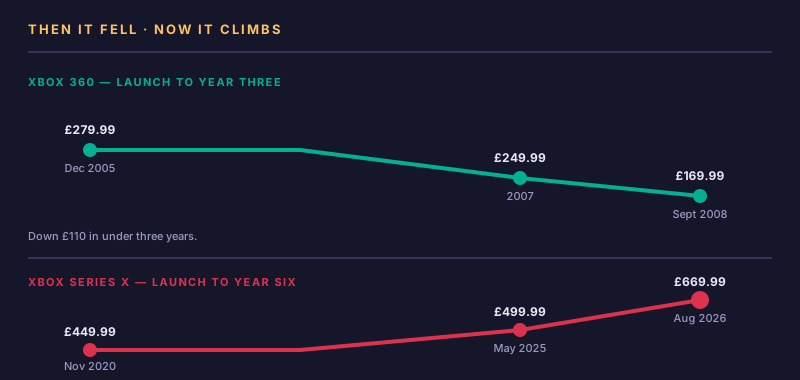
The Series X has now gone the other way twice. £449.99 at launch, £499.99 last year, £669.99 now. That's £220 more than launch, six years in, for identical hardware. There is no precedent for this in console gaming. None. It simply has never happened.
Who, exactly, is the person paying £669.99 for a 2020 console in 2026?
Because I genuinely can't picture them. It isn't the newcomer — they'd be mad not to buy a used one. It isn't the enthusiast — they already own it. It isn't the parent at Christmas, who is going to look at £669.99 next to a Switch 2 and make a very quick decision.
Is this the end of selling hardware at a loss?
The model everybody grew up with was razor-and-blades: sell the console at cost or below, make it back on software, accessories and subscriptions over the life of the machine. Sony lost money on early PS3s. Microsoft has been open for years that the box was never where the profit was.
That model needs one thing to work: enough consoles in enough houses. You eat the loss because every machine sold is an annuity. But if components cost so much that eating the loss would bankrupt you, the maths inverts — and the moment you price the hardware to make money on the hardware, you are no longer buying an installed base. You're just selling an expensive box to the people who were going to buy it anyway.
That's the bit that worries me more than the price itself. Not "Xbox is expensive this year", but "the mechanism that made consoles a mass-market product may have stopped working".
Does this soften us up for an all-digital, subscription future?
I'll be honest that this is the part where I have to check myself, because it's the most fun theory and therefore the one most likely to be wrong.

Here's what's true. The disc drive is a £50 premium. Game Pass exists, has had its own price rises, and is unambiguously where Microsoft wants you. Sony has already said there'll be no new PlayStation discs from January 2028. The direction of travel is not in dispute.
What I can't tell you is that the price rise is a deliberate lever to push people off physical media. The stated reason — memory costs — is real, verifiable and affects everyone including Sony and Valve. You don't need a plot when a component shortage explains it.
But motive and effect are different things. The effect is that physical gaming just got more expensive relative to digital, at exactly the moment the industry was already walking away from discs. Whatever the intent, the outcome points the same way, and it would be naive to think nobody at Microsoft has noticed.
Is Microsoft killing Xbox on purpose?
No. I don't think there's a room where someone decided to end it.
What I think is worse, actually, and more plausible: I think Xbox has stopped being a console business and nobody has said so out loud. Microsoft's games are on PlayStation now. Game Pass runs on your TV, your phone, your handheld. When your strategy is "Xbox is wherever you are", the box becomes just one more delivery mechanism — and if that particular delivery mechanism becomes unprofitable to subsidise, you stop subsidising it. Not out of malice. Out of indifference.
That's how platforms actually die. Not a decision — a series of individually reasonable calls that add up to a machine nobody has a reason to buy.
So does everyone just buy a Steam Machine?
This was my assumption when I started writing, and it's wrong, so I'll correct it in public.

Valve's Steam Machine arrived in June at £879 for the 512GB model, rising to £1,208 with a controller and 2TB. It is not the cheap alternative. It's £200 more than the console I've just spent an article calling too expensive — and Valve has been just as public about memory and storage costs squeezing them, because of course they have. It's the same shortage.
What Valve does offer is a library you already own, no subscription in the middle, and a machine that doesn't stop being useful when the platform holder loses interest. For someone with a decade of Steam purchases, that's a genuinely different proposition. But it is not a budget escape from expensive consoles. Nothing is, right now.
And that's the real answer to "where do people go?" They don't go to Steam. They go to a Switch 2, or to their phone, or to the second-hand shelf — or they don't upgrade at all, and they keep the machine they've got for another two years. Which, if you're a platform holder relying on an installed base, is the quietest possible catastrophe.
What I actually think
The memory shortage is real and I'm not going to pretend Microsoft invented it. But there's a difference between passing on a cost and passing on all of it, and it's telling that Sony absorbed £90 where Microsoft passed on £170.
A £170 rise on six-year-old hardware isn't a price adjustment. It's a signal — that this machine is no longer being sold to grow an audience, only to serve the people already holding one. Consoles getting cheaper as they aged was never a law of physics. It was a choice, made because platform holders wanted as many of us as possible inside the tent.
What happens now that they don't?